


General Overview of the Section 1205
Every five years, the World Customs Organization (WCO) amends the Harmonized System (HS), which is used around the world for international trade. Under section 1205 of the Trade Act of 1988 (19 U.S.C. 3005), the United States International Trade Commission (USITC) prepares amendments to the Harmonized Tariff Schedule of the United States (HTS) to conform the HTS with the HS amendments. The USITC issues a preliminary 1205 report containing draft amendments to the HTS and solicits public comments. The USITC’s preliminary report recommends that new HTS nomenclature be established based on the WCO’s amendments to the HS nomenclature. Thereafter, the USITC issues a final 1205 report recommending modifications in the nomenclature of the HTS. The USITC’s recommendations in the final USITC 1205 report are sent to the Office of the United States Trade Representative (USTR). USTR submits the final 1205 report to Congress for a 60-day lay-over period, after which the President proclaims the necessary modifications to the HTS nomenclature.
Current 1205 Investigation (1205-14)
Previous 1205 Investigations
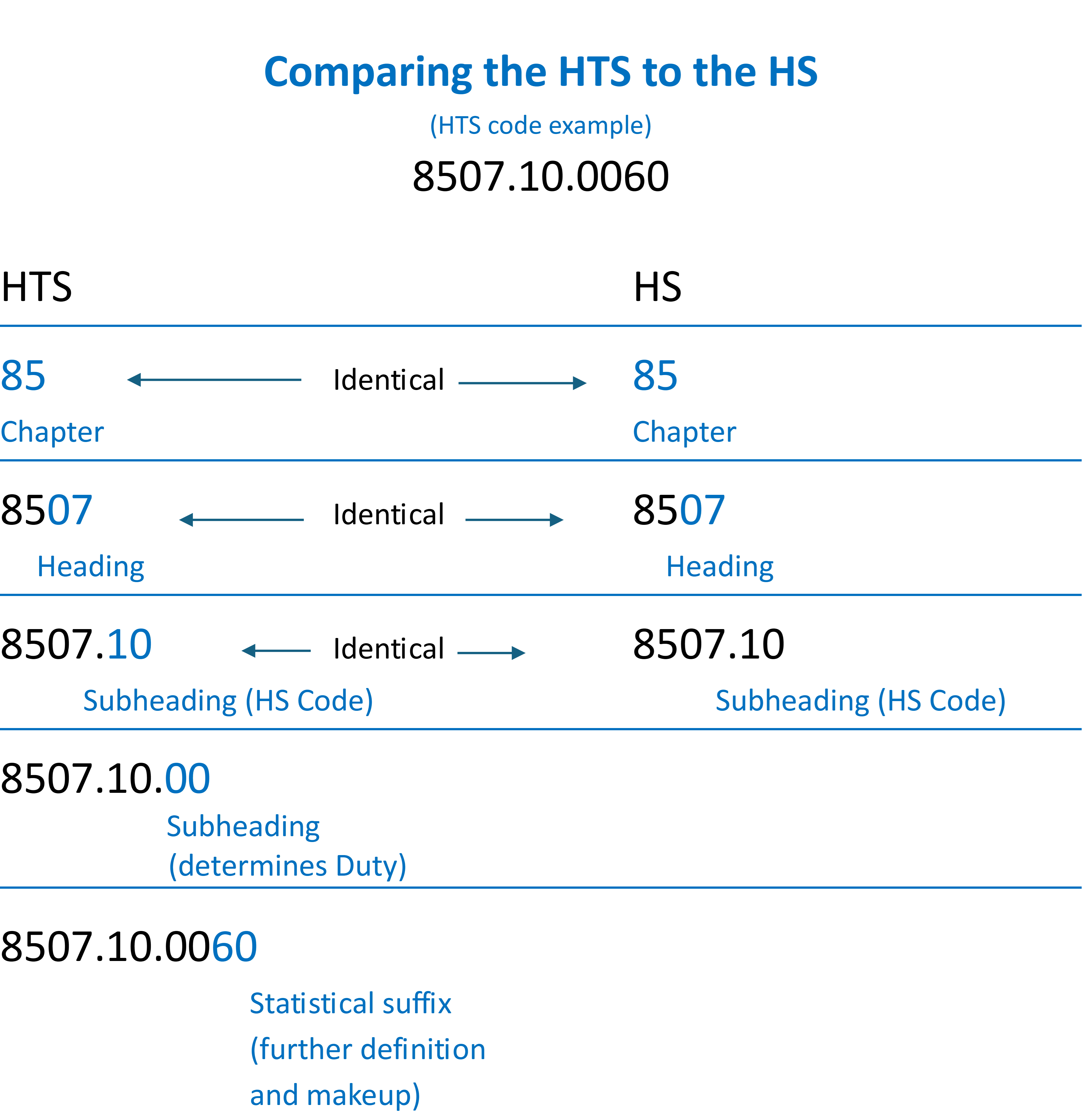
The HS is implemented under the International Convention on the Harmonized Commodity Description and Coding System (HS Convention) and maintained by the World Customs Organization in Brussels, Belgium. HS codes, which are applied by more than 200 countries and cover nearly all global trade in goods, are composed of a chapter (first two digits), a heading (first four digits), and a subheading (first six digits).
National tariff codes, including the Harmonized Tariff Schedule of the United States (HTS), provide additional digits at the end of an HS code to set rates of duty or provide product granularity information. For more information on the HS, see WCO "What is the Harmonized System (HS)?" page.
The HS is subject to continually rotating review cycles, with each cycle resulting in a new edition of the HS every five years containing a set of amendments. Amending the HS on a continual basis provides the opportunity to account for new types of technologies and changing patterns and volumes of international trade.
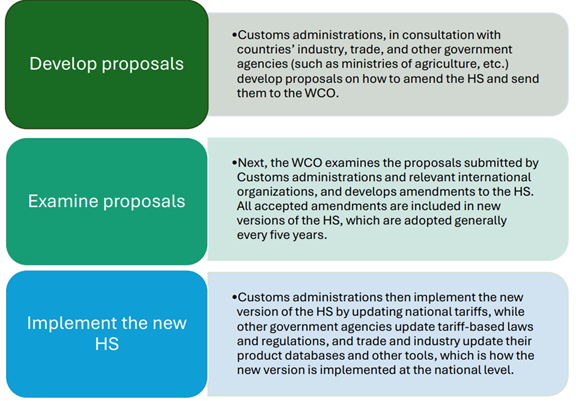
The diagram below provides an overview of the HS amendment process that takes place at the World Customs Organization. For more information on the amendment process, see the WCO "Amending the HS" page.
For information about submitting a proposal for the next HS cycle (HS 2033), see the Federal Register Notice for the WCO Eighth Review Cycle [PDF, 2 pages].